Kinetica Sports: Fuelling for GAA

Introduction
According to the Irish Sports Monitor (2025), Gaelic games remain the most popular sports for participation among adults and children in Ireland. A report published by Indecon (2023) found that more than 158,000 adults and almost 410,000 children participated in Gaelic football, while 204,000 children played hurling or camogie.
As the most widely played intermittent field sports in Ireland, Gaelic games place unique physical demands on players. Ensuring that athletes, coaches, parents, and volunteers understand the nutritional principles that underpin performance, recovery, and long-term health is essential across all levels of participation.
Understanding Gaelic Games
Gaelic football is played at both elite and sub-elite levels and forms part of the wider family of Gaelic games, which also includes hurling, camogie and handball.
Matches are contested between two teams of 15 players Most games last 60 minutes, divided into two 30-minute halves separated by a half-time interval. It is played by both males and females, although match duration and certain rules differ between competitions. At the elite male level, matches last 70 minutes, consisting of two 35-minute halves.
Training demands fluctuate throughout the season but typically include 1-2 gym-based strength sessions and 2-3 field-based team training sessions each week. The amateur nature of these sports means that players must balance training and competition with work, education and family commitments, which can impact nutritional habits.
The Playing Demands of Gaelic Games
Gaelic games are high speed, intermittent sports with frequent accelerations and decelerations. The demands on the players are dependent on their position. Midfielders cover the most distance, followed by the half-forward and half-back lines, and the full-back and full-forward lines taking part in less total distance throughout competitive games (Ryan et al., 2018, Byrne et al., 2024, Duggan et al, 2025, Collins et al, 2013).
Midfielders tend to do more high speed running and sprint frequencies (Reilly et al., 2015, Duggan et al., 2025). The research shows that the metabolic cost of the game is higher for midfielders. Half forwards and backs and full forwards and backs have a reduced metabolic demand. Regardless of these positional findings, sprinting is a component for all players in Gaelic football, which also includes jumping and kicking which would increase the anaerobic demands on a player (Reilly & Doran, 2001).
Malone and colleagues (2017) showed that total distance and high speed running were reduced in the final three quarters of the game when compared to the first quarter. The biggest drop off in distance and speed was directly correlated to players that did the most work. Midfielders had the biggest decrement in total distance and high speed running but were also the group that did the most work in terms of both variables.
Research also shows that physical performance drops off from the first half to the second half, while the third quarter of a game can see an increase in the second quarter, presumably due to half-time which gives an opportunity to recover and refuel or rehydrate (Collins et al., 2022, Molohan et al., 2022, Malone et al., 2017).
Nutrition Intake of GAA Players
It is widely reported that GAA players across different codes have poor nutrition knowledge (O’ Brien et al., 2019, Reeves & Collins, 2003, McCrink et al., 2021, Renard et al., 2020), resulting in the under consumption of carbohydrates (Collins et al., 2011, Reeves & Collins, 2003, O’ Brien et al, 2019). Not reaching the carbohydrate requirements set out in the nutritional guidelines may be contributing to decrements in performance that we have seen across the research conducted in Gaelic games match-play (Cassidy et al., 2018). Not consuming adequate carbohydrates on match day -1 may also result in poorer physical performances, which has been seen in various other sports, most likely due to sub-optimal carbohydrate availability (Burke et al, 2011). Fuelling any intermittent, high intensity activity is largely supported by carbohydrate intake (Bradley et al., 2016, Thomas et al., 2016).
Nutritional guidelines for intermittent, field sports like Gaelic games suggest that 5-7g of carbohydrate per kilogram of bodyweight is required to sufficiently fuel training (Burke et al., 2011, Thomas et al., 2016). Research conducted in GAA players regularly shows that their carbohydrate intake falls significantly short of this, at roughly 3.6g/kg and that players fail to alter their nutritional strategies and habits based on their training and rest days (O’ Brien at al., 2019, McCrink et al., 2021).
It has been shown that elite, inter-county players are closer to meeting their nutritional targets when compared to amateur players and in one study in particular, these players were closer to reaching their carbohydrate targets than in more recent studies (Reeves & Collins, 2003). The consideration here might be that inter-county players have access to performance nutritionists, and therefore their nutrition education may be more advanced than amateur players.
It must also be noted that a higher carbohydrate diet didn’t result in greater distances of running, but did show increases in sprint distance and less decrements in performance when comparing the second half with the first half performance (O’ Brien et al, 2021).
The final consideration with regards to nutritional intake and education is that there have yet to be nutritional guidelines set out directly for Gaelic games. Nutritional guidelines are speculative and extrapolated from other sports, including endurance sports, and therefore more research is needed with regards to elite and sub-elite Gaelic games.
How to Increase Carbohydrate Intake
Carbohydrate-rich foods are already part of most athletes’ diet, but meeting the higher carbohydrate requirements needed to support training and match performance often requires some planning. Day-to-day, the majority of carbohydrate intake should come from whole grains, fruit and veg, rice, pasta, potatoes, noodles, oats, whole grain cereals, whole grain breads and legumes. These foods not only provide carbohydrate but also deliver fibre, vitamins and minerals that support overall health and recovery.
Around training and competition, however, lower-fibre carbohydrate sources can be a practical choice. Because they are generally digested quicker, foods such as white bread, breakfast cereals, fruit juice, cereal bars and sports drinks can help athletes to increase carbohydrate intake without adding any fullness or stomach discomfort before exercise.
When training volumes increase or when preparing for matches, many athletes struggle to consume enough carbohydrates because they are too full, or they don’t understand how much food is needed in a practical sense. Foods like pancakes, bagels with jam or honey, breakfast cereals, muffins, rice cakes, smoothies and flavoured yogurts are all simple ways to increase carbohydrate intake without substantially increasing meal volume.
Planning ahead is equally important. Preparing meals and snacks in advance can help to guide busy days of balancing work or college schedules. Athletes should consume carbohydrates across their three main meals, with the addition of two to three snacks between meals. These snacks can include breads, cereals, energy bars, dried fruits, juices, smoothies, crackers, breadsticks and even flavoured milk.
When carbohydrate loading before matches, players often add larger portions of rice, potatoes or pasta. These foods should remain the foundation of their carbohydrate loading, however, adding larger portions could become monotonous and filling. Instead, combining different carbohydrate sources in the same meal can be an effective strategy. For example, serving a bread roll alongside a pasta dish or adding naan bread and mango chutney to a curry can be a more effective way of increasing carbohydrate intake.
This approach can help to overcome sensory-specific satiety. This is the gradual decline in enjoyment of food as more of the same food is eaten. Introducing different flavours and textures can help to make a meal more appealing and easier to consume.
How can Kinetica Sports Supplementation Can Help
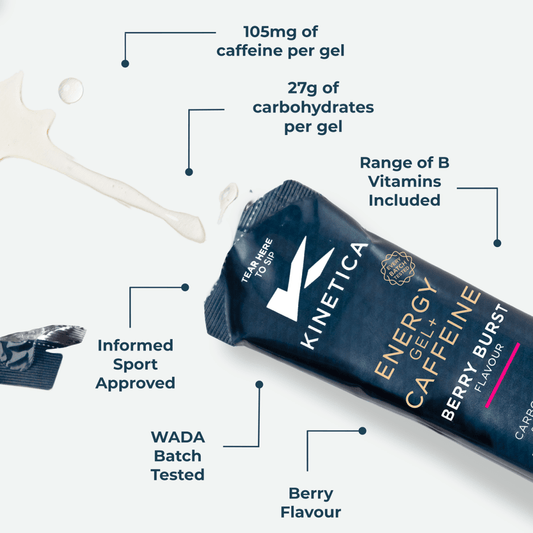
Carbohydrate supplements can often be used around the dressing room before, during or after training and matches. Carbohydrate gels are one of the most common forms of pre and intra-game carbohydrate top ups. Kinetica Sports energy gels provide 24g of carbohydrate which are quickly digested. Sports drinks can also be used at these times if carbohydrate gels aren’t well-tolerated.
It is generally advised to consume 30-60 grams of carbohydrate per hour during exercise (Pfeiffer et al, 2010, Thomas et al, 2016). Gels, sports drinks and foods like jellies, plain biscuits and fruit can help to reach those targets.
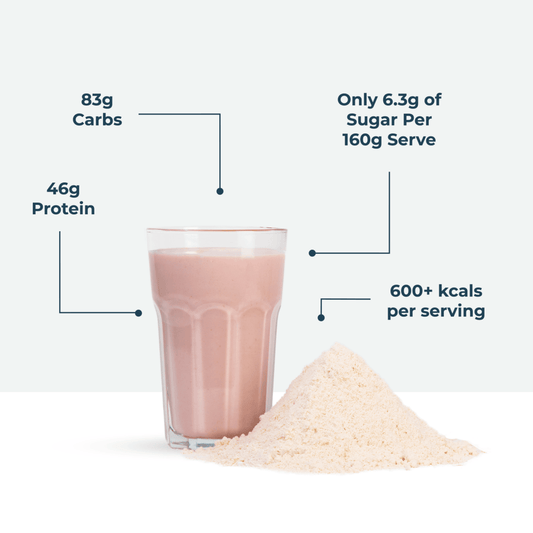
Other options include Kinetica Sports OatGain which can be consumed throughout the day or around exercise to supplement a busy routine or a high-carbohydrate diet. One serving can provide around 80g of carbohydrate.
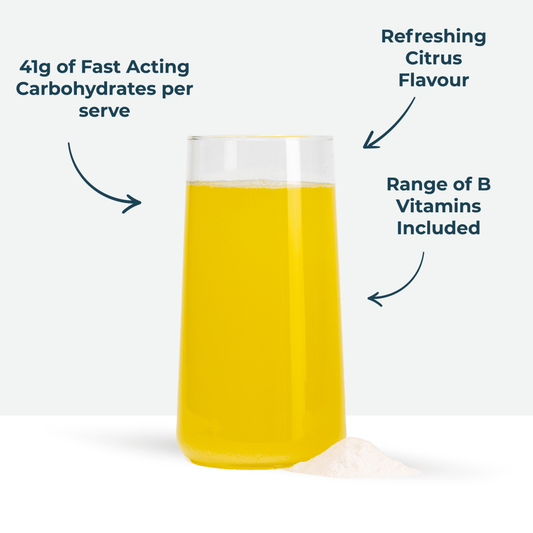
Kinetica Sports Recovery provides 41g of carbohydrate per serving which can be included post training or match, as well as Kinetica Sports Energy which offers the same carbohydrate content without a protein serving. This can be used during a match or at half-time if specific carbohydrate requirements are needed. For example, some players may not tolerate a typical 6-8% carbohydrate solutions like a sports drink. A carbohydrate powder can allow these players to dilute these drinks to their own specific preference while supporting their performance on the pitch.
Conclusion
Carbohydrates are the primary fuel for high intensity, intermittent field sports and play a key role in supporting training quality, match performance, and recovery. In the absence of sport-specific nutrition guidelines for Gaelic games, GAA athletes should aim for 5-7g of carbohydrate per kilogram of bodyweight per day during periods of high training load and competition.
Meeting these carbohydrate targets does not have to rely solely on traditional carbohydrate-rich meals. Foods such as breads, cereals, rice, pasta, potatoes, fruit, fruit juice, sauces, and convenient snacks including popcorn or rice cakes can all contribute to daily intake. Sports nutrition products may also be useful around training sessions and matches when convenience, timing, or individual nutritional requirements make whole foods less practical.
Research consistently shows that many GAA athletes fail to consume sufficient carbohydrate to meet the demands of training and competition. Improving daily carbohydrate intake can help maintain muscle glycogen stores, support repeated high-intensity efforts such as sprinting and high-speed running, and promote more effective recovery between training sessions and matches. Ultimately, a well-planned carbohydrate strategy is a simple yet effective way for Gaelic games athletes to maximise performance while supporting long-term training adaptations and overall health.